Each year on May 1, we recognize the beginning of Asian American and Pacific Islander (AAPI) Heritage Month—a time to celebrate the rich histories, cultures, and contributions of communities that have helped shape our nation in profound ways.
The roots of this observance date back to 1978, when AAPI Heritage Week was first established to commemorate two significant milestones: the arrival of the first Japanese immigrants to the United States in 1843, and the completion of the transcontinental railroad in 1869—built in large part by Chinese immigrant laborers whose contributions were essential, yet long overlooked. Over time, this recognition expanded into a full month, officially designated in 1992.
The term “AAPI” is often used as a broad, collective identity, but it represents an incredibly diverse group of people whose roots span vast regions of the world. This includes East Asia (such as China, Japan, and Korea), Southeast Asia (including Vietnam, the Philippines, Thailand, Cambodia, and Laos), South Asia (such as India, Pakistan, Bangladesh, Sri Lanka, and Nepal), and the Pacific Islands (including Native Hawaiian, Samoan, Tongan, Chamorro/Guamanian, and Fijian communities, among many others).
Within these regions are hundreds of distinct ethnicities, languages, traditions, and lived experiences. While the acronym “AAPI” can create a sense of unity and shared advocacy, it is important to recognize that each community carries its own cultural identity, migration story, and lived experience—including the impact of colonization, displacement, exclusionary laws, and systemic inequities. From the Chinese Exclusion Act of 1882 to the incarceration of Japanese Americans during World War II, AAPI history reflects both profound resilience and resistance in the face of injustice.
The contributions of AAPI individuals have also helped shape the cultural, political, and social fabric of the United States. From Kristi Yamaguchi, an Olympic gold medalist who inspired a generation of athletes, to Kamala Harris, the first woman, first Black American, and first person of South Asian descent to serve as Vice President, these milestones reflect progress, representation, and possibility. Leaders, artists, activists, scientists, and community builders across AAPI communities continue to break barriers, amplify voices, and create lasting change—reminding us that representation matters and that every story contributes to our shared history.
Prominent AAPI figures in Hollywood—including Michelle Yeoh, Ke Huy Quan, Sandra Oh, Mindy Kaling, and Dwayne Johnson—have helped expand representation and visibility across film and television. Their work reflects both recent progress and the long-standing efforts of AAPI artists who have challenged barriers and reshaped the industry. Authors like Jenny Han have also played a powerful role in shaping representation, bringing AAPI characters and stories into the mainstream and onto the screen through bestselling novels.
Beyond Hollywood, AAPI leaders have made lasting contributions across advocacy, civil rights, and science. Activists like Grace Lee Boggs dedicated their lives to social justice, community empowerment, and organizing for equity, while scientists such as Kalpana Chawla broke barriers as the first woman of Indian origin in space, inspiring generations through her achievements and legacy.
Here in Los Angeles, we see and experience this richness every day—from the vibrant streets of Chinatown to the cultural heartbeat of Koreatown, to the comforting, layered flavors of pho shared across our communities. Spaces like the USC Pacific Asia Museum in Pasadena help preserve and elevate the stories, artistry, and histories that continue to shape our region. Our AAPI communities are an essential part of what makes Los Angeles so dynamic, bringing distinct traditions, languages, music, and perspectives that enrich the fabric of our city.
At Penny Lane, our commitment to diversity, equity, inclusion, and belonging calls us to move beyond generalizations and take time to learn, listen, and honor the individuality within communities. AAPI Heritage Month is not only a celebration, it is an invitation. An invitation to deepen understanding, uplift voices that have too often been overlooked, and reflect on how we continue building spaces where everyone feels seen, respected, and valued.
If you’re looking for ways to engage this month, our local community offers a wide range of opportunities to learn, celebrate, and connect:
Throughout this month, we encourage you to explore the histories, stories, and contributions of AAPI communities, attend local events, support AAPI-owned businesses, and engage in meaningful conversations with curiosity and care.
Because when we truly see one another in our full humanity, we strengthen the very foundation of belonging.
-Judy Grant, Penny Lane Centers
As we enter May—a month that recognizes and uplifts multiple communities and experiences—we are reminded of the importance of creating space to honor the many identities that shape who we are.
After a pause in 2025, we are excited to reintroduce the Cultural Spotlight to our monthly Newsletter. This space was created to highlight the rich cultural backgrounds, traditions, and lived experiences of our Penny Lane team members, and to deepen our collective understanding of one another.
Culture is not one-dimensional. It lives in our families, our communities, our histories, and our daily experiences. It influences how we see the world, how we connect with others, and how we show up in our work.
As we relaunch this series, we do so with intention—recognizing that in a time when many communities are experiencing increased division, misunderstanding, and harm, creating space for storytelling, visibility, and connection is more important than ever.
We invite you to read, reflect, and engage with this Cultural Spotlight, featuring Ryan Myvett, who shares reflections on his Belizean American identity, cultural traditions, and the experiences that have helped shape his journey.
Ryan Myvett, LMFT, serves as the Program Manager of Penny Lane’s Transitional Housing Program, overseeing both the North Hills and Lancaster sites, which support 44 non-minor dependents in extended foster care. May marks 15 years with Penny Lane—a journey rooted in commitment, connection, and care for the young people he serves.
Ryan describes his cultural identity as a Black Belizean American, shaped by the traditions, values, and teachings of his parents, who are from Central America. His upbringing was grounded in structure and respect at home—but beyond that front door, life required a very different kind of awareness.
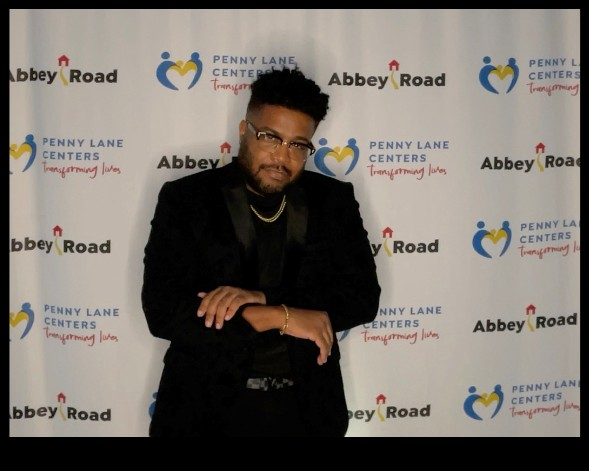
“I grew up constantly in survival mode, always making decisions that put my safety first so that I can make it home to my family every day,” he shares.
Raised in Mid-City Los Angeles and later in the Crenshaw district in an area known as “The Jungles,” Ryan learned early how to navigate environments impacted by gang activity. Those experiences continue to shape him today. “Even though I no longer live in that environment, I still find myself making decisions that put the safety of myself and others first.”
This duality—of a structured Belizean household and an unpredictable external environment—deeply informs Ryan’s work. He understands firsthand the challenges many of the young people in Penny Lane’s programs face and uses his lived experience to guide and support them.
“I try to use my experience on how I was able to navigate that landscape and stay out of trouble to give the young folks in our programs advice on how to stay safe.”
Ryan began his journey at Penny Lane as a residential counselor, where his role was centered on maintaining safety and modeling positive behavior for youth ages 12–18. It was in that space that he built relationships, listened to their stories, and supported them in navigating peer pressure and difficult choices. Today, as a program manager, that same commitment continues—meeting young people where they are and helping them move forward with intention and care.
Music has always been a strong connection to Ryan’s cultural roots. Growing up, reggae filled his home, especially during weekends when his mother would play music during her weekly deep cleaning. One song in particular still resonates with him: “Reggae Jam” by Lord Laro.
“It really captures the essence of what Belize is to me,” he says. “As I got older, I understood that the message of the song is that no matter what happens, don’t let it stop you from doing what you want to do.”
Food is another meaningful connection. Ryan reflects on how, as a child, he sometimes took those traditions for granted. “Growing up as a kid I took it for granted, asking ‘can we get McDonald’s?’” he shares. Today, those same meals carry deep appreciation. A plate of rice and beans with stew chicken and fried plantains is now something he truly savors. He also highlights fried jack—a fried dough often paired with eggs and other breakfast staples—as a favorite that connects him back to home.
One of the most significant cultural celebrations for Ryan is Belizean Independence Day, observed on September 21, 1981—the day Belize gained independence and its national identity. It remains a meaningful moment of pride and reflection.
Through his story, Ryan offers a powerful reminder of how culture, environment, and lived experience shape not only who we are, but how we show up for others. His journey reflects resilience, awareness, and a deep commitment to supporting young people as they find their own path forward.
Ryan’s story is a powerful reflection of how culture, lived experience, and personal resilience shape the way we show up for others. At Penny Lane, we remain committed to honoring and celebrating the diverse identities, backgrounds, and perspectives that strengthen our community. Through spaces like the Cultural Spotlight, we continue to live out our values—Commitment, Community, and Collaboration—by creating opportunities to learn from one another, build deeper connections, and foster a true sense of belonging across our organization.
-Judy Grant, Penny Lane Centers
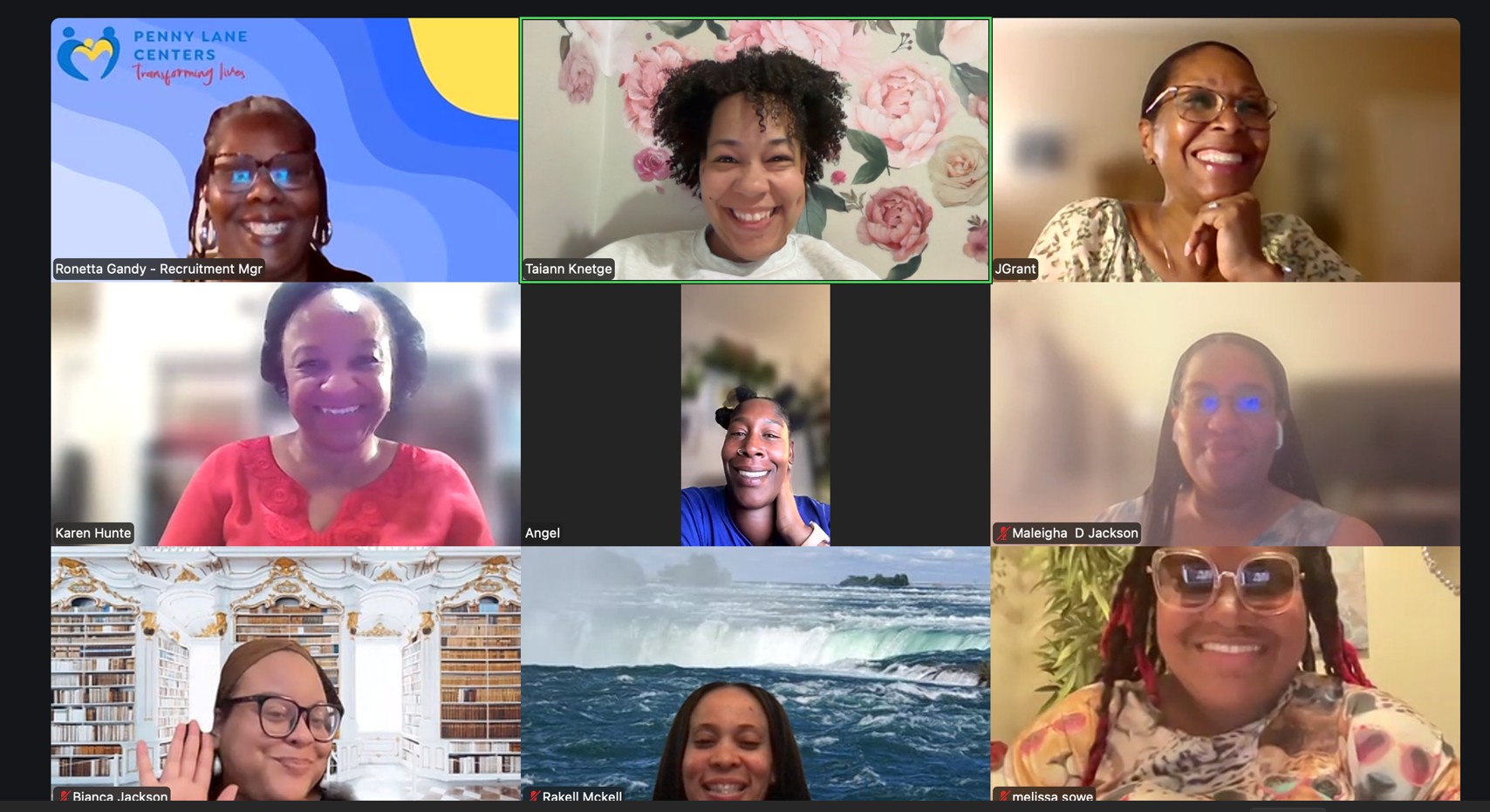
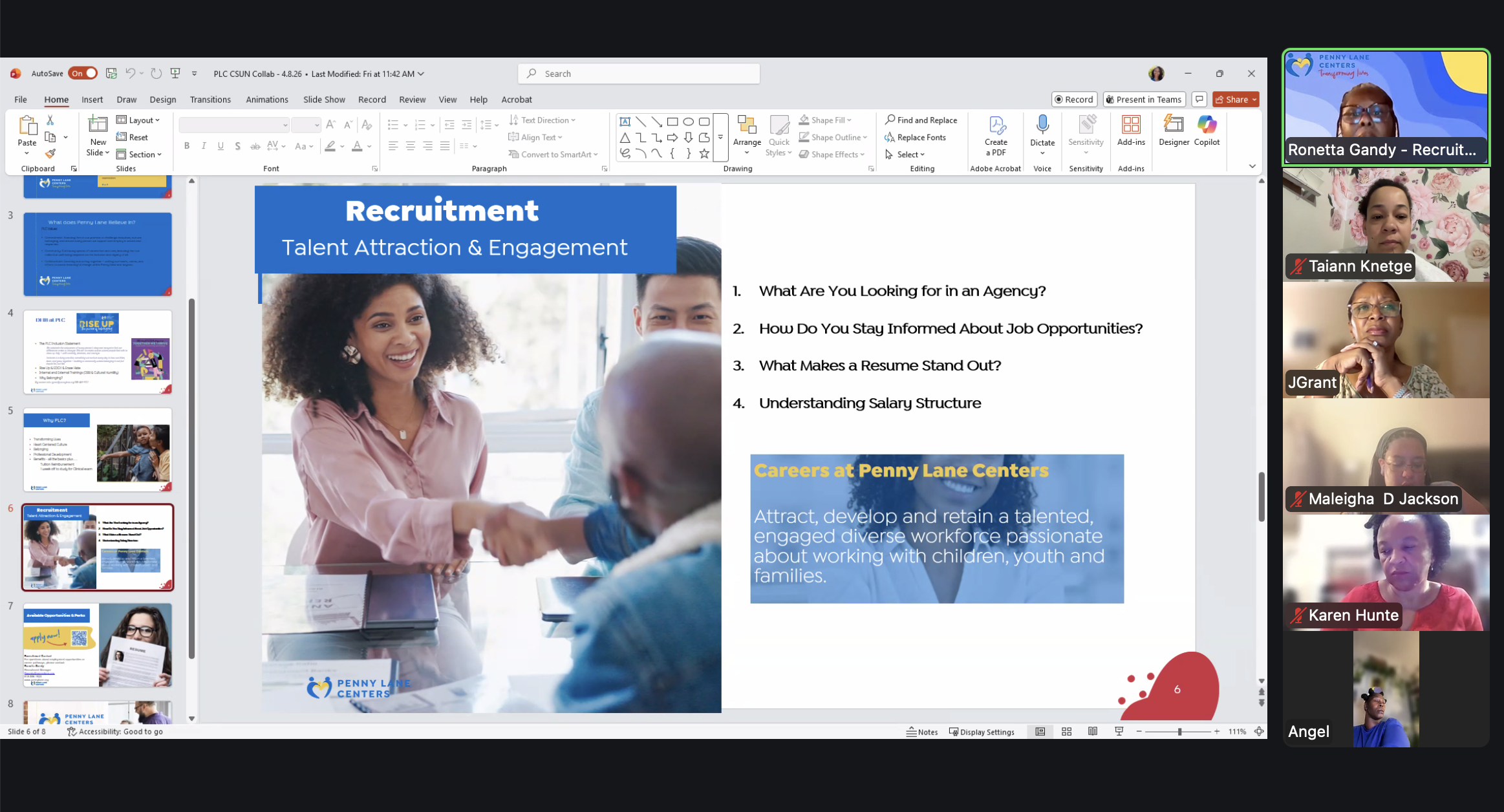
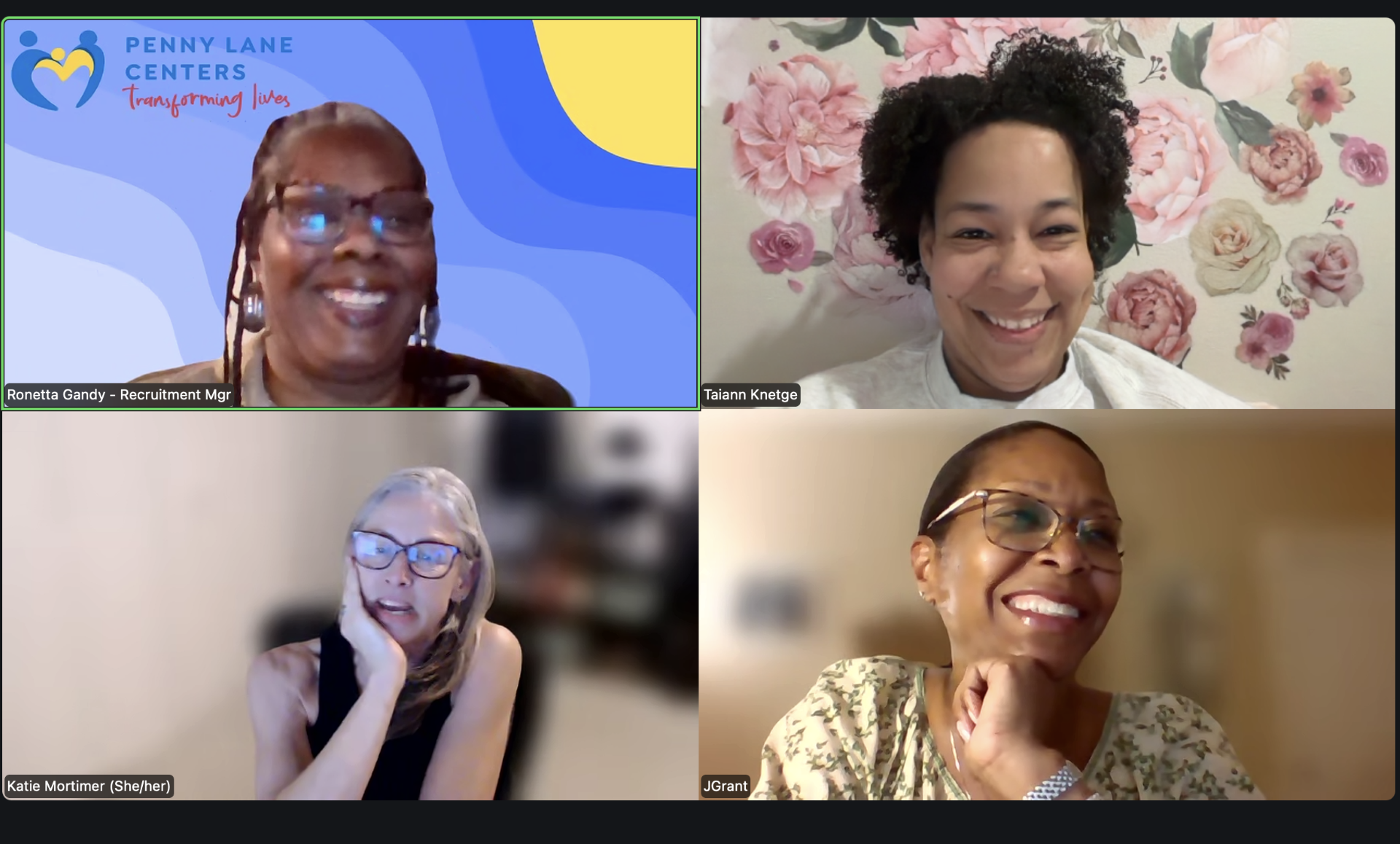
On Wednesday, April 8th, from 8:15 to 9:45 p.m., Penny Lane Centers had the opportunity to connect with members of the Black Social Workers Caucus at California State University, Northridge (CSUN). While the late hour may seem unconventional, it was intentionally chosen to meet the needs of working professionals and graduate students—an early reflection of the flexibility and responsiveness that defines our work.
In collaboration with Professors Taiann Knetge and Katie Mortimer, this engagement created space for meaningful dialogue about who we are as an organization and why our work matters. While recruitment was certainly an underlying goal, the heart of the conversation extended far beyond that. It was about connection, visibility, and offering a deeper understanding of Penny Lane’s mission and impact.
Alongside HR Recruitment Manager Ronetta Gandy, we highlighted Penny Lane’s history, our commitment to our core values and Core Gifts, and the ways we continue to embed Diversity, Equity, Inclusion, and Belonging (DEIB) into our daily practices. The conversation was dynamic and engaging, with students actively participating and asking thoughtful questions about our Core Gifts, the realities and challenges of working at Penny Lane, and how to navigate the Board of Behavioral Sciences (BBS) process as emerging professionals.
Ronetta also provided valuable insight into what it means to build a career at Penny Lane. She spoke about the benefits and opportunities available to staff, while offering practical guidance on resume development and navigating the job search process. With many of the attendees preparing to graduate this spring, the conversation was both timely and impactful, equipping them with tools, perspective, and confidence as they prepare for their next chapter.
It was clear throughout the evening that Ronetta’s passion for this work runs deep. She spoke authentically about why she believes in Penny Lane and how we strive each day to transform lives, both internally within our teams and externally in the communities we serve. That authenticity resonated, helping to create a space where students could see themselves not just as applicants, but as future contributors to meaningful, purpose-driven work.
Most importantly, the evening reinforced the importance of showing up in spaces where future leaders are already gathering. By meeting students where they are, listening to their experiences, and sharing openly about both the opportunities and challenges of this work, we continue to build pathways for connection, growth, and belonging.
Check out some more photos below!