


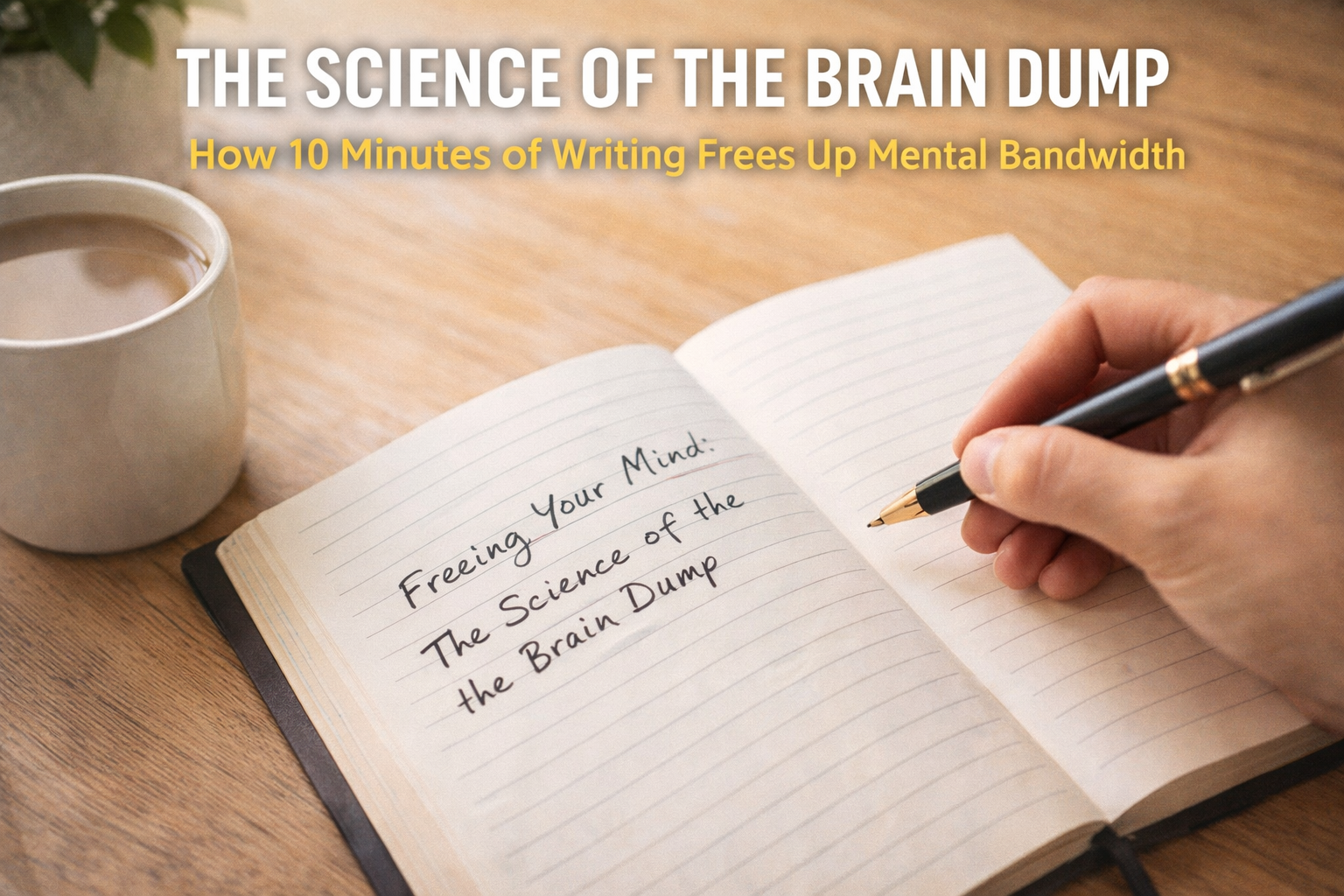

In a world that refuses to stop shouting, opening your journal is the only way to finally hear yourself think. Journaling is a way to give your brain a much-needed exhale. Throughout the day, our minds get cluttered with a million tiny tabs—worries about work, random to-do lists, and lingering feelings from a conversation that didn't go so well. When you sit down to write, you aren't just recording events, you are moving that "mental noise" out of your head and onto the page. This very simple act of clearing space helps lower your stress levels and allows you to feel much lighter as you continue to move through your day. A systematic review and meta-analysis published in JMIR Mental Health found that journaling resulted in a statistically significant reduction in scores for anxiety (9%) and PTSD (6%), suggesting it is a highly effective, low-cost addition to traditional therapy (Sohal et al., 2022).
Writing things down also helps you become an observer of your own life. It’s easy to get caught up in a cycle of the same old habits or frustrations without really knowing why. However, when you see your thoughts staring back at you in ink, it’s a lot easier to spot the patterns. Especially a negative thinking pattern - it’s easier to spot your Negative Nancy at work. You might realize that you always feel anxious on a certain day of the week or that you're harder on yourself than you’d ever be to a friend. This "birds-eye view" can give you the clarity to make better choices instead of just reacting to everything that happens to you. Pioneer research in Psychological Science established "Emotional Disclosure Theory," showing that organizing chaotic thoughts into a written narrative improves mental clarity and long-term mental strength (Pennebaker, J.W., 1997).
Finally, journaling serves as a personal anchor in a world that often feels too fast and too digital. It’s one of the few times during the day when you aren't being told what to think by a screen or an algorithm. Whether you’re writing down three things you’re grateful for or just venting about a bad day or a conversation, you are building a relationship with yourself. A landmark study on gratitude journaling showed that participants who wrote about things they were thankful for reported a 25% increase in life satisfaction and better sleep quality (Emmons & McCullough, 2003). Over time, your journals become a map of your growth, proving to you that you’ve survived hard days before and giving you the confidence to handle whatever comes next.
Paper doesn't argue and ink doesn't judge—journaling is the only place where you can be completely honest without an audience. May I invite you to a journaling sesh? Name one specific moment from the last 24 hours that made you feel safe, seen, or capable? Spill the ink!
-Biridiana Baez, Penny Lane Centers


