


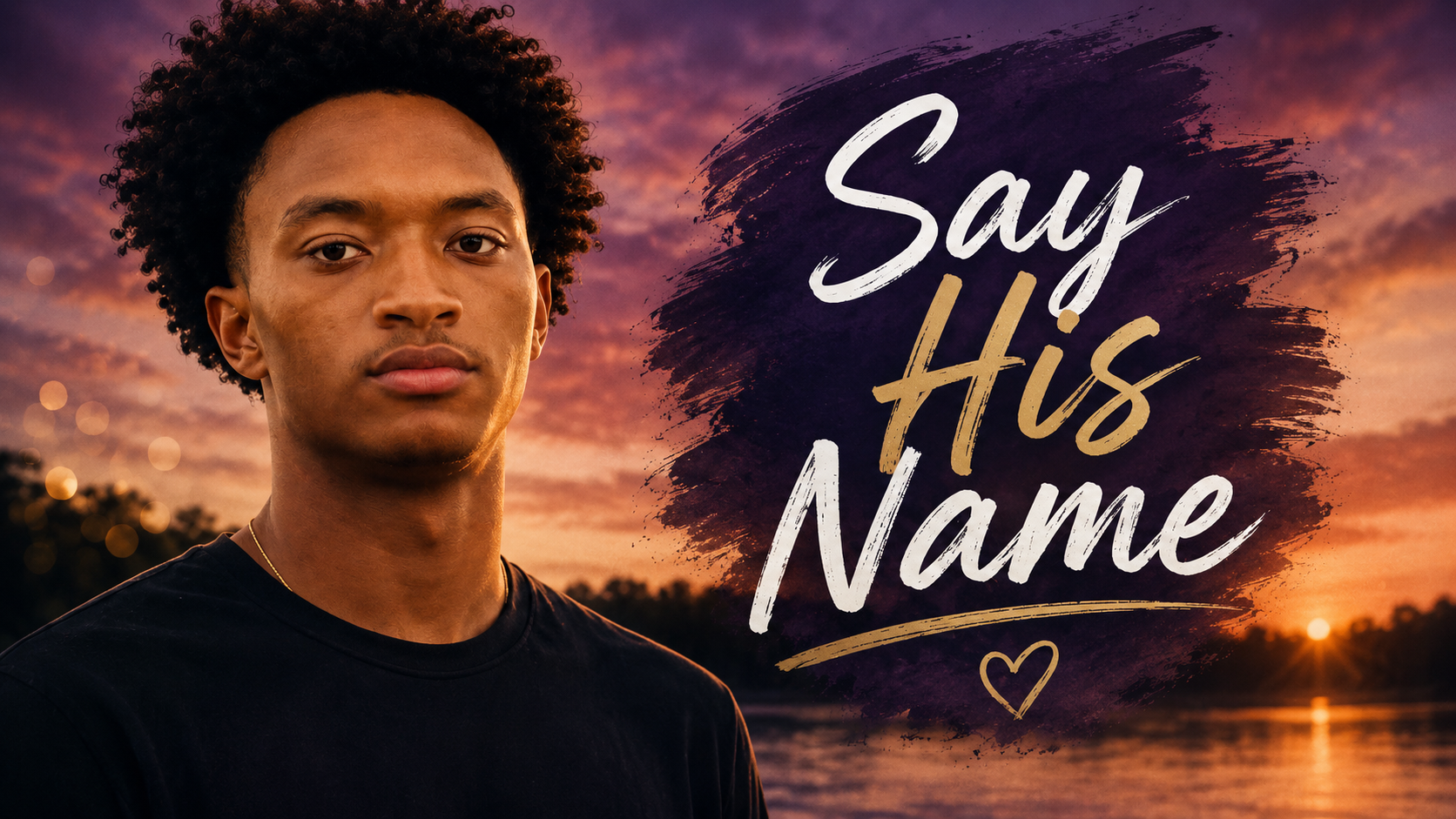
There are moments when a news story stops being just another headline.
It captures our attention, settles into our hearts, and quietly asks something of us.
The death of 18-year-old Nolan Xavier Wells is one of those moments.
On the Fourth of July, Nolan joined friends for a day on the water. He never returned home. Days later, his body was recovered, leaving his family, friends, and community grieving an unimaginable loss. As the investigation continues, many questions remain unanswered, and it is important that we allow the facts to emerge before drawing conclusions. Truth matters. So does transparency.
But there is another truth that exists alongside the investigation.
A family has lost their son.
A brother is mourning his sibling.
Friends are grieving someone whose laughter, kindness, and presence can never be replaced.
Before Nolan became a headline, he was simply a young man with dreams, relationships, and a future that had only just begun. His parents have described him as "a bright light" whose smile and energy were infectious—a young man who was loving, hardworking, and made friends wherever he went.
The death of Nolan Xavier Wells has touched countless hearts across our nation. For me, however, his story resonates on another level.
Nolan was a young Black man.
As I read the headlines, I found myself thinking not only about Nolan, but about the names that came before him—young Black men and women whose deaths have left families searching for answers and communities struggling with grief. Every case is different. Every investigation deserves to be guided by facts. Yet each new loss reopens wounds that have never fully healed for many Black Americans.
It is impossible for me not to think of names such as Tamla Horsford, Lauren Smith-Fields, Daniel Erving, and so many others whose families continue to seek truth, healing, and peace. While each story is unique, together they remind us why so many Black families carry an added layer of fear that others may never fully understand.
That is the weight many families carry.
When a Black child walks out the door, there is often an unspoken prayer that accompanies them:
Come home safely.
We encourage our children to dream boldly. We celebrate their independence. We cheer them on as they build friendships, pursue their education, and experience all the joy that youth has to offer.
But more than anything, we want them to come home.
Safely.
The truth is that every parent deserves that same peace of mind.
Regardless of the color of their skin, every child deserves the freedom to spend time with friends, celebrate milestones, explore the world, and return home to the people who love them. Every family deserves the comfort of knowing that the child they hugged goodbye will walk back through the front door.
That hope should never depend on race.
It should simply be part of our shared humanity.
It is easy to become consumed by the mystery surrounding Nolan's death. We naturally want answers. We want to understand what happened. We want justice where justice is warranted.
His parents want those things too.
In heartfelt public statements, they have asked for honesty, transparency, and a thorough investigation. Yet, during their unimaginable grief, they have also urged people not to rush to judgment or direct threats toward those they believe may have been involved. Their plea is both remarkable and deeply moving. Even while carrying the unbearable weight of losing a child, they have chosen compassion over vengeance and truth over speculation.
There is a lesson in that for all of us.
We live in a world where information travels instantly. Headlines are shared before facts are known. Opinions often arrive before evidence. Social media can amplify anger faster than understanding. In moments like these, it can be tempting to fill the silence with assumptions.
But compassion asks us to do something different.
Compassion asks us to pause.
To remember that every headline represents a human life.
To remember that every investigation affects real people.
To remember that every family deserves truth, dignity, and respect.
At Penny Lane, we speak often about belonging. We strive to create spaces where every person feels welcomed, valued, respected, and knows they belong. Belonging is more than an organizational value; it is a way of seeing one another's humanity.
When we truly believe people belong, we recognize that every life has inherent worth. We resist the temptation to reduce people to headlines or sound bites. We make room for grief. We choose empathy over indifference. We refuse to let another person's pain become ordinary.
Nolan's story reminds us why this work matters.
Not because we have all the answers.
But because every life deserves to matter.
Every family deserves compassion.
Every community deserves truth.
And every person deserves to know that they belong.
To Nolan's family, we extend our deepest condolences. May the cherished memories of Nolan bring comfort during your darkest moments. May you find strength in the love that surrounds you, peace in the support of your community, and hope in the pursuit of truth. We mourn with you, and we honor the life of your beloved son.
So today, I ask only one thing.
Say his name.
Not because we know every answer.
Not because the investigation is complete.
But because saying his name reminds us that he was here. That he mattered. That behind every headline is a family forever changed.
May we honor Nolan Xavier Wells by choosing compassion over assumption, empathy over indifference, and hope over despair. May we continue building communities where every person is seen, every voice is valued, and every life is treated with dignity.
Because that is what belonging asks of us.

We just asked you to Say His Name. Nolan—a young Black man whose life was cut short far too soon. We reflected on the painful reality that behind every headline is a person, a family, and a community left to grieve.
Sadly, in this article we ask you to Say Their Names.
Lorenzo Salgado Araujo.
Joan Sebastián Durán Guerrero.
There are moments when finding the right words feels nearly impossible.
The recent fatal shootings involving federal immigration enforcement have left many of us grieving, questioning, and searching for understanding. Families have lost loved ones. Communities are carrying fear. Children are witnessing events that no child should ever have to experience. Regardless of where we stand on immigration policy, the loss of human life should never become something we accept as routine.
On July 7, 2026, 52-year-old Lorenzo Salgado Araujo, a Mexican construction worker, was fatally shot during a traffic stop involving federal immigration enforcement officers in Houston, Texas. According to the Department of Homeland Security, he was not the intended target of the operation.
Then, on July 13, 2026, 26-year-old Joan Sebastián Durán Guerrero, a Colombian national, was fatally shot in Biddeford, Maine, after driving away from a residence under federal surveillance. Authorities likewise reported that he was not the individual they were seeking.
While each of these incidents is unique and the facts continue to unfold, they share one undeniable truth: lives have been lost, families have been forever changed, and communities are carrying the weight of profound heartbreak.
These stories often begin as local news. A neighborhood mourns. A community gathers. Loved ones search for answers. But they should never end there. Behind every headline is a person whose life mattered, whose absence leaves an empty seat at the dinner table, an unanswered phone call, and a family forever altered.
Say their names.
Not because they are defined by how they died, but because they lived. Because they mattered. Because every life represents a family, a history, a future, and a place in this world that can never be replaced.
These are not the first fatalities associated with immigration enforcement, and they are unlikely to be the last unless meaningful reflection, accountability, and a commitment to preserving human life remain at the center of these encounters. At what point do we ask ourselves, when is enough enough? It is a difficult question, but one we cannot afford to ignore.
At Penny Lane, we recognize that immigration is a complex issue with deeply held and differing opinions. We also believe there are values that transcend politics. Every person deserves to be treated with dignity. Every family deserves to feel safe. Every child deserves to know that the adults entrusted with protecting our communities will do everything possible to preserve life.
For many of the children, youth, and families we serve, these events are not simply stories in the news. They reinforce fear, uncertainty, and trauma within immigrant communities. We know that living under constant stress affects mental health, family relationships, school performance, and a child's sense of belonging. Our responsibility is not only to provide services, but also to create spaces where people feel seen, supported, and valued.
History reminds us that when preventable deaths become commonplace, we risk becoming desensitized to suffering. We cannot allow ourselves to reach that place.
So today, we remember.
We remember Lorenzo Salgado Araujo.
We remember Joan Sebastián Durán Guerrero.
We say their names—not as a political statement, but as an affirmation of our shared humanity.
Because every name tells a story.
Every life leaves an imprint.
And every person deserves to be remembered.


